A beat rarely sounds amateur because it is missing another limiter. More often, the sounds were fighting before the mix began. A weak kick, an unstable 808 or three layers doing the same job force you into corrective processing that never feels finished.
If you want to know how to make beats sound professional, start at selection. These seven mistakes are easy to hear once you know what to test.
1. Choosing by solo sound instead of musical role
A huge kick can sound exciting alone and still be wrong for the beat. Every sample occupies time, frequency and stereo space. Choose it for the role it must play beside the bass, melody and vocal—not for how impressive it sounds in a browser.
Audition drums while the main loop is playing. If the kick must cut through a dense melody, prioritize a defined transient. If an 808 already owns the sub range, choose a kick with less low-end tail. The right sample often sounds smaller alone because it leaves room for the record.
2. Ignoring the envelope
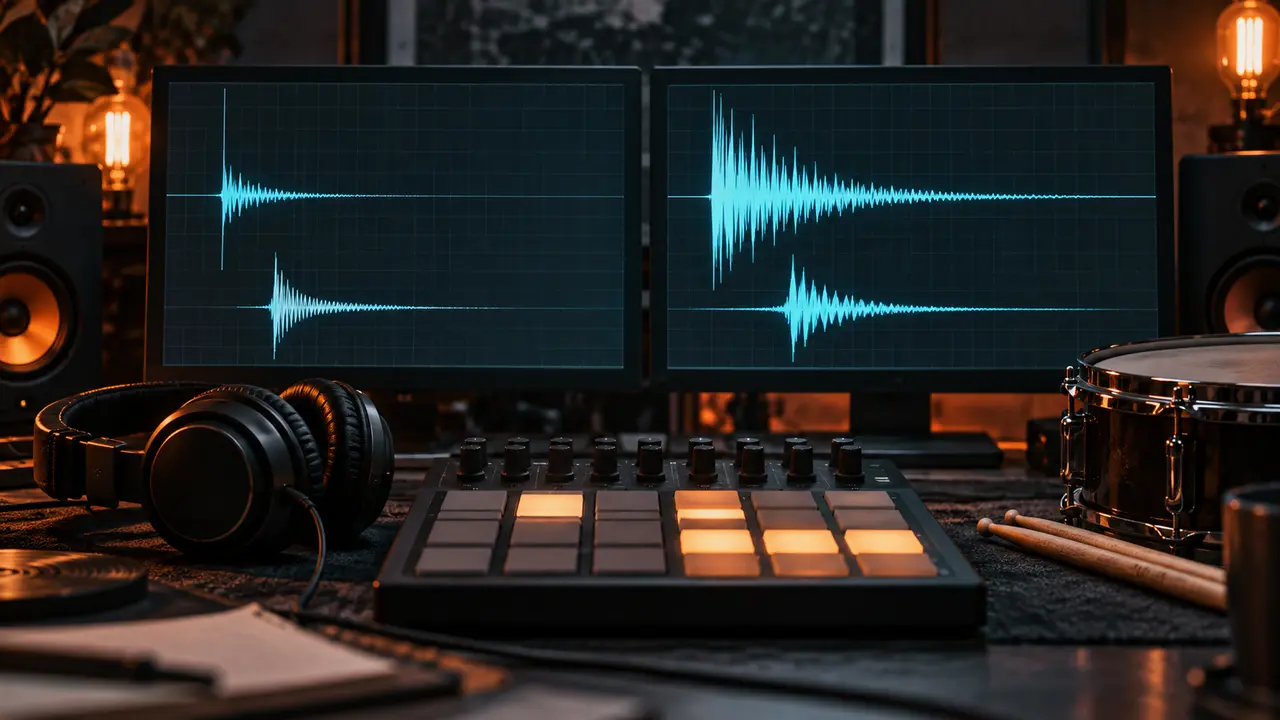
Length is part of sound selection. A kick with a long decay can blur into the next 808 note. An open hat that rings through a snare may weaken the backbeat. A snare with a slow attack can feel late even when it is on the grid.
Before adding EQ, shorten the sample envelope. Use a fade or sampler release, then listen again. If the groove becomes clearer, the problem was time-domain overlap. Packs with varied short and long choices—such as the public Trap Drum Kits collection—make this decision faster.
3. Layering sounds with the same job
Layering is useful when each layer contributes something specific: one kick for sub weight, one for attack; one snare for body, one for width. Stacking three full-spectrum kicks creates phase problems and unpredictable peaks.
A disciplined layering check
- Name the purpose of each layer before keeping it.
- Flip polarity and adjust timing when low frequencies disappear.
- High-pass the attack layer if the body layer already owns the low end.
- Compare the layer against the best single sample at matched loudness.
If the layered version is not clearly better in context, use one sound. Simplicity usually produces a stronger transient and more headroom.
4. Using an 808 without tuning it
An 808 is both a drum and a bass instrument. Identify its fundamental pitch, set the sampler root note correctly and write notes that support the harmony. Do not trust the filename automatically; verify it with a tuner or spectrum display, then confirm by ear.
Some 808s change pitch during the attack. Tune the stable portion of the tail, not the initial click. For more detailed low-end technique, read Best 808 Drum Kits & Sample Packs in 2026.
5. Selecting only bright, loud samples
Bright samples win quick A/B tests because they appear detailed, but a whole beat made from bright sounds becomes tiring. Professional arrangements need contrast: dry against roomy, dark against bright, short against sustained.
Lower every candidate to roughly the same perceived level. Then choose the tone that supports the hierarchy. The vocal or lead should not compete with a hat that already occupies every high-frequency gap.
6. Fixing the wrong sample with processing
EQ can shape a good sample; it cannot reliably turn the wrong sample into the right one. If you are making five large cuts, aggressive transient shaping and extreme saturation just to place a snare, audition another snare first.
Set a limit: after two purposeful moves, compare an alternative. A focused kit such as the Trap Drum Kit or Trap One Shot Kit “Horizon” can make that search more coherent because the sounds share a stylistic direction.
7. Never committing to a small palette
Constant replacement stops you from developing the beat. Choose a temporary palette—perhaps two kicks, two snares, three hats and two 808s—and write the first full arrangement with it. Replace a sound only when you can describe the problem it creates.
This rule separates production from browsing. Once the structure works, make a second pass for sound design and detail. You will judge samples against a real arrangement instead of an unfinished loop.
Ten-minute selection routine
- Set the melody and bass level below clipping.
- Audition five kicks in context and keep two.
- Choose one backbeat with the right length and tone.
- Add one hat that defines the subdivision.
- Tune the 808 and check kick interaction.
- Commit, arrange and revisit only clear problems.
Check the arrangement at three listening levels
Sound selection changes with playback level. At a comfortable studio level, judge tone and movement. At very low volume, check whether the kick, snare, vocal space and main melody still form a clear hierarchy. At a briefly louder level, listen for harsh hats, uncontrolled bass notes and layers that create tiring peaks.
Then use one small speaker or headphones you know well. Do not rebuild the mix for every device; identify repeated problems. If the same snare disappears everywhere, choose a sample with a clearer center. If only the deepest 808 notes vanish on small speakers, add controlled harmonics or select a source with more upper content. These checks keep processing tied to a specific reason.
Finally, bypass the mix-bus chain and compare again at matched loudness. If the beat collapses without the limiter, return to the palette and channel balance. A professional rough mix should already communicate impact before mastering makes it louder.
Conclusion
Professional sound comes from compatible choices, clear roles and controlled contrast. Select in context, tune the 808, keep layers purposeful and stop browsing once the palette works. The mix becomes easier because it is refining good decisions instead of rescuing bad ones.